
Brixton Metals Reports Up to 96.9% Gold Recovery and 97.3% Copper Recovery from Three Zones of the Camp Creek Porphyry-Epithermal System
Mr. Gary Thompson reports:
VANCOUVER, British Columbia, Nov. 05, 2026 (GLOBE NEWSWIRE) -- Brixton Metals
Corporation (TSX-V: BBB, OTCQX: BBBXF) (the “Company” or “Brixton”) is pleased
to announce initial scoping-level metallurgical testwork results from the Camp Creek system at its wholly owned Thorn Project in NW British Columbia, Canada. The Company tested three composites of core representing the main mineralization styles at Camp Creek: the copper-molybdenum-gold porphyry at depth (Porphyry X), the near-surface Oban Breccia, and the high-sulphidation gold-silver-copper veins of the upper Camp Creek system (Figure 2). All three responded well to conventional gravity concentration and rougher flotation. These results follow the initial metallurgical results from the Trapper Gold Target (October 20, 2026 News Release) and provide a first indication of metal recoveries at Camp Creek ahead of the maiden Mineral Resource Estimate (“MRE”) now being prepared with APEX Geoscience Ltd. for both the high-sulphidation zone and the deeper porphyry, which the Company expects to report in the first quarter of 2027.
Highlights
- Initial scoping-level testwork on three composites from the Camp Creek system returned combined gravity and rougher flotation gold recoveries of 88.8% to 96.9% and silver recoveries of 88.2% to 95.7%
- Porphyry X composite (0.52% Cu, 0.22 g/t Au, 519 ppm Mo): rougher flotation recovered 97.2% of the copper, 88.4% of the molybdenum and 88.3% of the gold into a rougher concentrate grading 3.20% Cu, 0.32% Mo, 2.05 g/t Au and 43.7 g/t Ag, for an overall gold recovery of 88.8%
- Oban Breccia composite (3.77 g/t Au, 1,280 g/t Ag, 0.93% Cu): overall recoveries of 93.1% gold and 93.9% silver, with a rougher concentrate grading 9.94 g/t Au, 2,966 g/t Ag and 2.30% Cu and a copper rougher recovery of 97.3%
- Near-surface high-sulphidation veins composite (3.44 g/t Au, 148 g/t Ag, 0.77% Cu): overall recoveries of 96.9% gold and 95.7% silver; gravity concentration alone recovered 6.0% of the gold into a concentrate grading 279 g/t Au
- Camp Creek is a kilometre-scale system with a long record of wide, well-mineralized intercepts, including 554.70 m of 0.57 g/t Au, 43.18 g/t Ag and 0.24% Cu in the Oban
Breccia (THN19-150) and 967.71 m of 0.25% Cu, 0.09 g/t Au, 2.39 g/t Ag and 186 ppm Mo in the porphyry (THN22-201)
Gary R. Thompson, Chairman and CEO, stated, “Camp Creek is a large, vertically zoned system, with high-sulphidation gold-silver-copper veins and breccia near surface and a broad copper-gold-silver-molybdenum porphyry at depth. These initial metallurgical results show that each mineralization style responds well to a conventional gravity and flotation flowsheet, with gold recoveries up to 96.9% and copper rougher recoveries above 97%. Together with the Trapper results reported earlier this month, this testwork gives us an early positive result of metallurgy across the Thorn Project and is a key step toward maiden resource estimates expected in early 2027.”
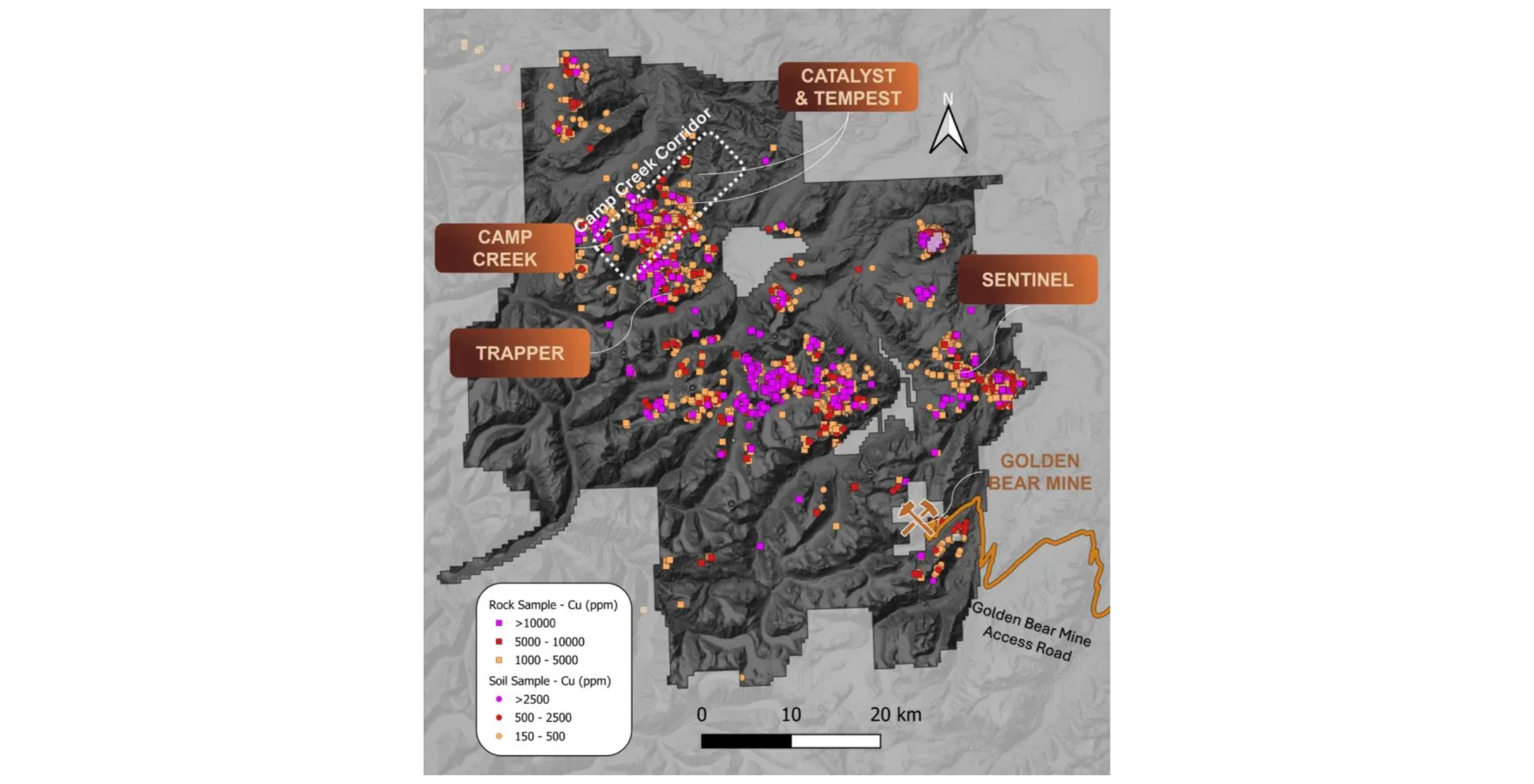
Figure 1. Location of Targets at the Thorn Project with Copper-in-rock-soil Geochemistry.
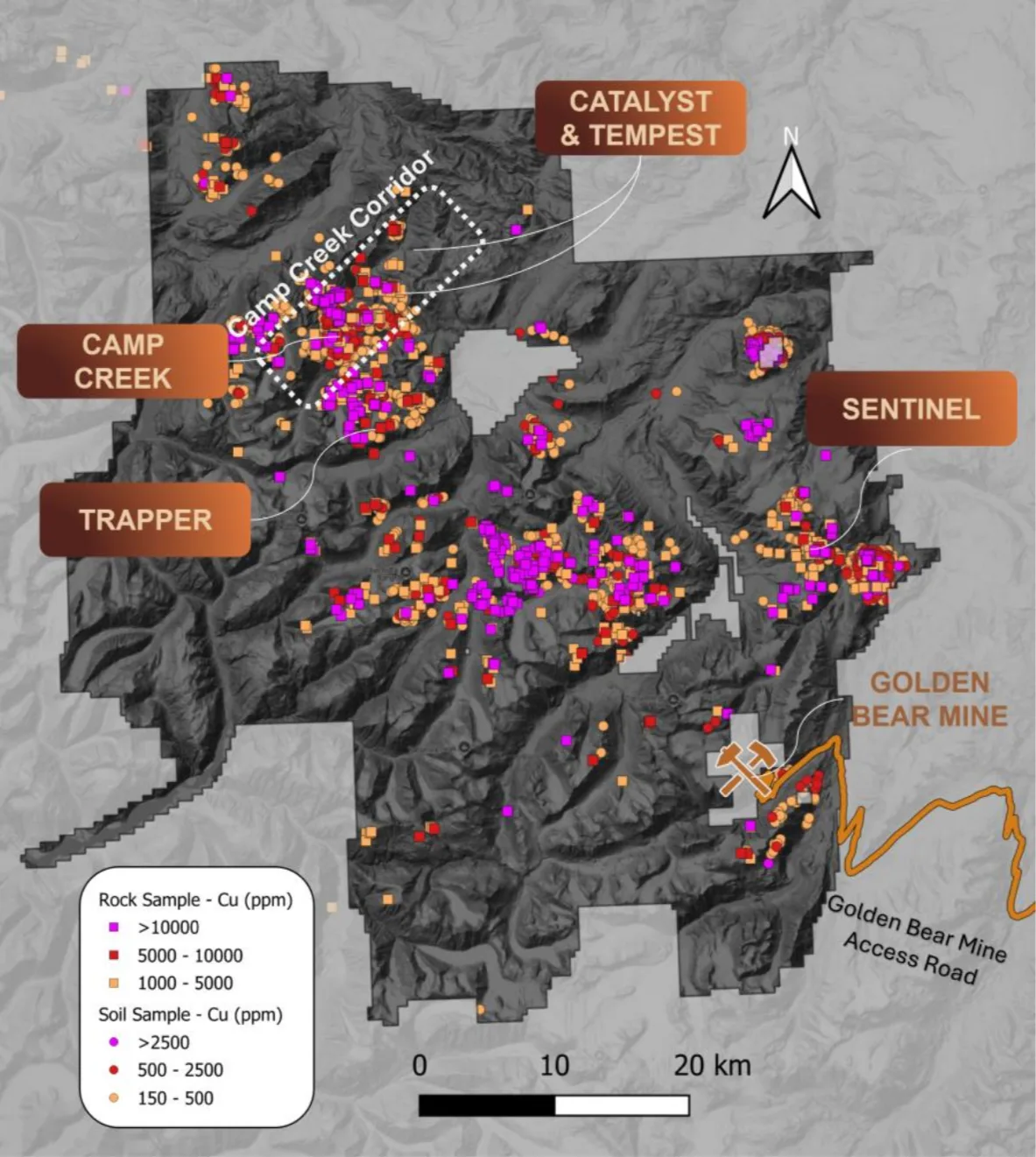
Figure 2. Camp Creek conceptual model looking northeast, showing the near-surface high-sulphidation zone, including the Glenfiddich, Northside and Talisker vein systems and the Oban Breccia, and the mineralized porphyry at depth, open in multiple directions, with selected previously reported intercepts.
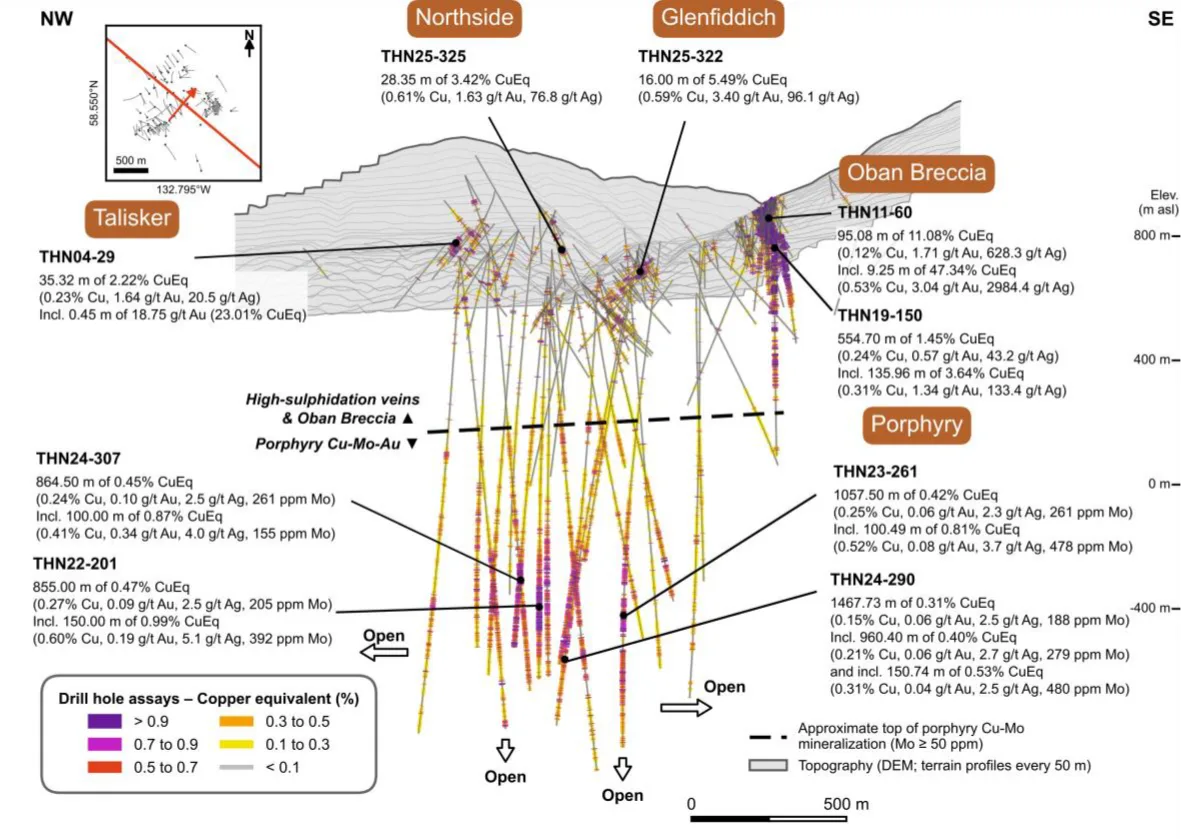
Copper equivalent (CuEq) is calculated using US$4.75/lb Cu, US$3,500/oz Au, US$50/oz Ag and US$20/lb Mo, and recoveries of 97.1% Cu, 92.9% Au, 92.6% Ag and 73.0% Mo, the average of preliminary gravity and rougher-flotation results on three composites (Porphyry, Oban Breccia and high-sulphidation veins). CuEq (%) = Cu (%) + 1.0281 × Au (g/t) + 0.01464 × Ag (g/t) + 3.1655 × Mo (%). Cleaner-flotation recoveries have not been determined and may be lower. Intervals are core lengths; true widths are not known. Long section looking N040°E with all Camp Creek drill holes projected; no vertical exaggeration.
Table 1. Summary of initial gravity and rougher flotation results, Camp Creek composites (Trapper shown for reference).
Overall Cu Mo Overall Au Ag Cu Au rougher rougher Ag Composite head head head recovery recovery recovery recovery (g/t) (g/t) (%) (%) (%) (%) (%)
Porphyry X 0.22 <10 0.52 88.8 97.2 88.4 88.2
Oban
3.77 1,280 0.93 93.1 97.3 77.4 93.9
Breccia High-
sulphidation 3.44 148 0.77 96.9* 96.9* 53.1* 95.7*
veins* Trapper
10.3 27.6 – 97 – – Pending
(reported
Oct. 20, 2026)
Head grades are direct assays of the composites; gold is the average of duplicate fire assays. Overall recoveries combine gravity concentration with rougher flotation stages 1–2 of the gravity tailings. *For the high-sulphidation veins composite, rougher results are based on stages 1–3. Rougher flotation results do not reflect final recoveries, which are typically lower after cleaning stages.
Discussion
The testwork provides a first indication of how the principal mineralization styles at Camp Creek respond to conventional processing, using the same gravity and rougher flotation flowsheet applied to the Trapper composite (see About the Metallurgical Results and Table 3). Gold recoveries were high in all three composites, and copper reported strongly to the rougher concentrate in each case, with copper rougher recoveries of 96.9% to 97.3%.
The Porphyry X composite, representing the copper-dominant porphyry at depth, upgraded from 0.52% Cu and 519 ppm Mo in the head to a rougher concentrate grading 3.20% Cu and 0.32% Mo, with rougher recoveries of 97.2% for copper and 88.4% for molybdenum. Acid-soluble copper was about 1% of total copper, indicating minimal oxide copper.
The Oban Breccia composite, the most silver-rich of the three at 1,280 g/t Ag, produced a rougher concentrate grading 2,966 g/t Ag and 9.94 g/t Au, consistent with the silver-rich, polymetallic character of the breccia seen in previous drilling.
The high-sulphidation veins composite returned the strongest gravity response and the highest overall gold recovery of the Camp Creek composites, with 6.0% of the gold reporting to a gravity concentrate grading 279 g/t Au and 96.9% overall gold recovery.
The Oban Breccia and high-sulphidation veins rougher concentrates carried 40.2% and 46.9% of the feed mass, respectively, reflecting head sulphur grades of 12.0% and 17.2%. The next phase of testwork will include cleaner flotation to reject this sulphide and upgrade the concentrates, and will assess the deportment of lead, zinc and antimony, which are elevated in the Oban Breccia composite. The results will be incorporated, with the 2026 drill results, into the maiden Camp Creek MRE.
Figure 3. Plan map of the Camp Creek area showing the high-sulphidation vein systems, the Oban Breccia, the footprint of porphyry drilling and the drill holes sampled for the metallurgical composites. Trace line of cross section in Figure 2.
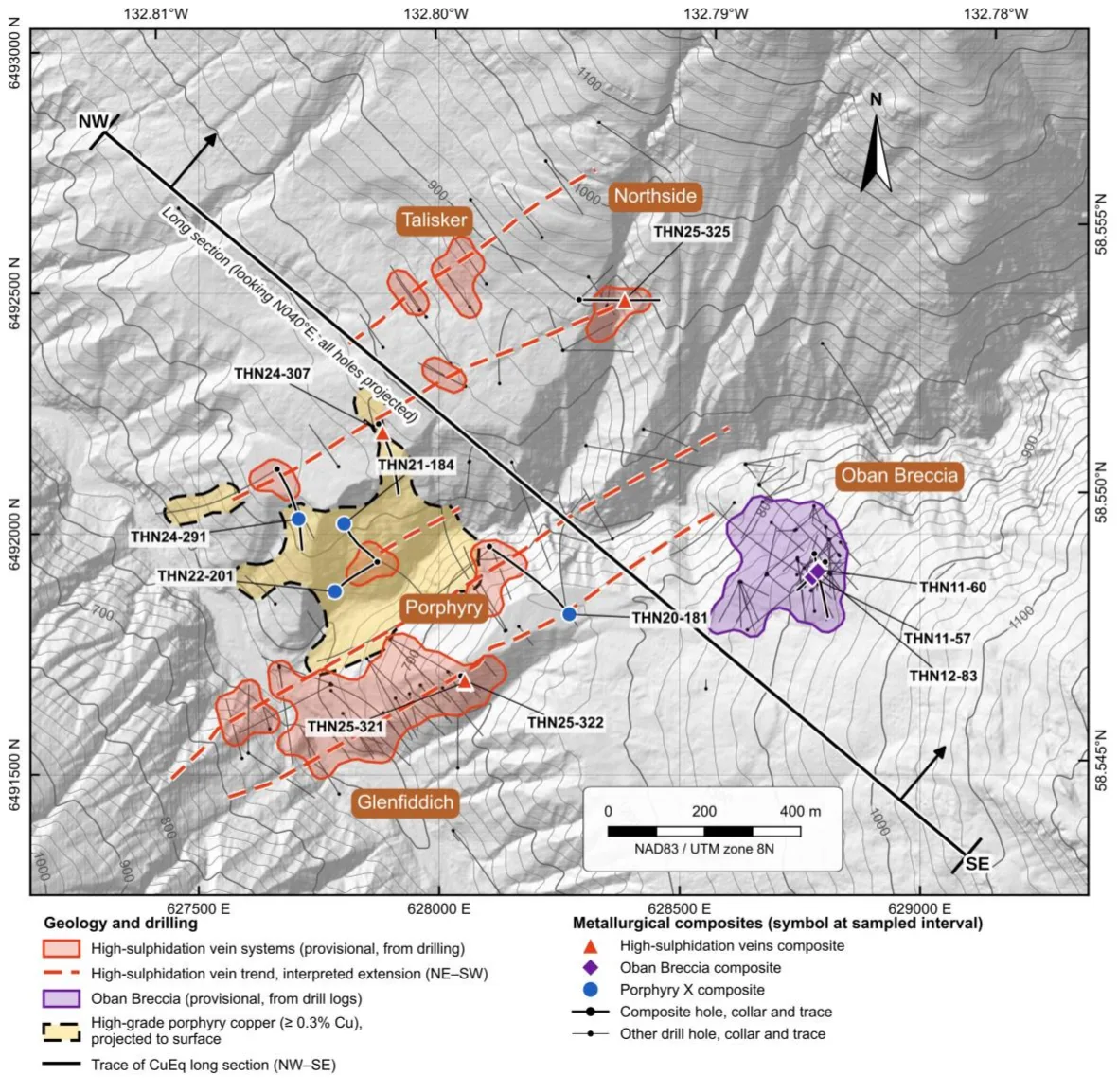
Hillshade and 20 m contours (100 m labelled, m asl) from the 1 m DEM. Grid north; UTM coordinates NAD83 zone 8N. Drill traces are desurveyed and projected to plan. High-grade porphyry copper = 10 m downhole composites ≥ 0.3% Cu below the top of porphyry Cu-Mo mineralization (Mo ≥ 50 ppm), projected vertically to surface and buffered 30 m; the composites lie about 600 to 1,600 m below surface. Vein and breccia outlines are provisional and derived from drilling only: veins = clusters (≥ 3 holes or ≥ 20 samples) of samples ≥ 1.0% CuEq above the porphyry; Oban Breccia = logged hydrothermal breccia above 300 m asl; both buffered 25 m. CuEq basis as in the long section. Dashed vein trends are interpreted NE–SW extensions between and beyond drill intercepts.
The Camp Creek System
Camp Creek is the most advanced target on the Thorn Project (Figure 1, 2) and is interpreted as a single, vertically zoned porphyry-epithermal system. The upper part of the system is a near-surface high-sulphidation zone that includes the Glenfiddich, Northside and Talisker gold-silver-copper vein systems and the Oban diatreme breccia, and is marked at surface by intense jarosite to acid-sulphate alteration. Beneath it, a blind calc-alkalic copper-gold-silver-molybdenum porphyry begins at approximately 300 m depth and has been intersected by drilling across an area of approximately 1.5 km by 2 km, to depths of more than 1,500 m. The Company interprets the high-sulphidation veins as the shallow expression of, and feeder structures to, the porphyry at depth (Figure 2).
Drilling in the upper system has returned wide gold-silver-copper intervals with high-grade cores. At the Oban Breccia, a polymetallic diatreme breccia pipe, hole THN11-60 returned 95.00 m of 1.70 g/t Au and 628.00 g/t Ag from 6.00 m depth, including 9.25 m of 3.04 g/t Au and 2,984.00 g/t Ag, and hole THN19-150 returned 554.70 m of 0.57 g/t Au, 43.18 g/t Ag and 0.24% Cu from 97.00 m depth, including 135.96 m of 1.35 g/t Au, 133.62 g/t Ag and 0.31% Cu.
In the vein systems, highlights include 16.00 m of 3.40 g/t Au, 96.08 g/t Ag and 0.59% Cu in hole THN25-322 at Glenfiddich Zone, and 14.75 m of 1.71 g/t Au, 149.00 g/t Ag and 1.25% Cu in hole THN26-372 at Glenfiddich, including 1.50 m of 11.30 g/t Au, 971.00 g/t Ag and 8.33% Cu. In the Northside Zone hole THN25-325 returned 28.35 m of 1.63 g/t Au, 76.79 g/t Ag and 0.61% Cu. All of the northeast trending high-sulphidation zones remain open along strike and down dip.
At depth, the strongest porphyry mineralization is hosted in Porphyry X, a crowded plagioclase porphyry of Cretaceous age characterized by stacked biotite, and in the Triassic Stuhini Group sedimentary rocks that it intrudes. Deep drilling since 2020 has returned broad intervals of copper-gold-silver-molybdenum mineralization, including 976.52 m of 0.22% Cu, 0.07 g/t Au, 2.06 g/t Ag and 154 ppm Mo in hole THN21-183; 967.71 m of 0.25% Cu, 0.09 g/t Au, 2.39 g/t Ag and 186 ppm Mo in hole THN22-201, including 150.00 m of 0.60% Cu, 0.19 g/t Au, 5.13 g/t Ag and 391 ppm Mo; and 647.83 m of 0.26% Cu, 0.11 g/t Au, 2.70 g/t Ag and 274 ppm Mo in hole THN24-307, including 50.00 m of 0.54% Cu, 0.58 g/t Au, 5.33 g/t Ag and 176 ppm Mo. Several holes, including THN21-184 and THN24-290, ended in mineralization, and the porphyry remains open in multiple directions.
Table 2. Selected previously reported drill intercepts from the Camp Creek system.
Interval Hole ID Zone Au (g/t) Ag (g/t) Cu (%) Mo (ppm) (m)
THN11-60 Oban Breccia 95.00 1.70 628.00 0.12 – including 9.25 3.04 2,984.00 0.53 – THN19-150 Oban Breccia 554.70 0.57 43.18 0.24 – including 135.96 1.35 133.62 0.31 – THN25-322 Glenfiddich 16.00 3.40 96.08 0.59 – THN25-325 Northside 28.35 1.63 76.79 0.61 – including 8.77 2.52 120.87 1.22 THN26-372 Glenfiddich 14.75 1.71 149.00 1.25 – including 1.50 11.30 971.00 8.33 – THN21-183 Porphyry 976.52 0.07 2.06 0.22 154 THN21-184 Porphyry 821.25 0.28 2.44 0.24 174
THN22-201 Porphyry 967.71 0.09 2.39 0.25 186 including 150.00 0.19 5.13 0.60 391 THN24-307 Porphyry 647.83 0.11 2.70 0.26 274 including 50.00 0.58 5.33 0.54 176
All intervals are drill core lengths and were previously reported by the Company; true widths are not known for all intervals. Grades are length-weighted averages; “–” indicates not reported.
Quality Assurance & Quality Control
The metallurgical composites were prepared from drill core sampled under the Company’s standard protocols, summarized below. Quality assurance and quality control protocols for drill core sampling were developed by Brixton. Core samples were mostly taken at 1.50 m intervals. High-grade intervals were taken at 0.50 to 1.50 m intervals. Blank, duplicate (lab pulp) and certified reference materials were inserted at a combined rate of up to 15%. Core samples were cut in half, bagged, zip-tied and sent directly to the ALS Minerals preparation facility in Whitehorse, Yukon, or Langley, British Columbia, depending on available lab capacity. ALS Minerals laboratories are registered to ISO 9001:2015 and accredited to ISO/IEC 17025:2017 for laboratory procedures. Samples were analyzed at ALS Laboratory Facilities in North Vancouver, British Columbia, for gold by fire assay with an atomic absorption finish, whereas Ag, Pb, Cu, Zn, and 48 additional elements were analyzed using four-acid digestion with an ICP-MS finish. Over-limit gold samples were analyzed using fire assay and gravimetric finish. The standards, certified reference materials, were acquired from CDN Resource Laboratories Ltd., of Langley, British Columbia, and the standards inserted varied depending on the type and abundance of mineralization visually observed in the primary sample. Blank material used consisted of non-mineralized siliceous landscaping rock. A copy of the QA/QC protocols is available on the Company’s website.
About the Metallurgical Results
Brixton has received initial scoping-level metallurgical test results from SGS Canada Inc., an independent laboratory. SGS analysis was conducted on three composites of drill core from the Camp Creek system, representing the Porphyry X mineralization, the Oban Breccia and the high-sulphidation veins. Each composite was ground to a target primary grind size of 80% passing 75 μm (P80) and processed through a Knelson concentrator, with the Knelson concentrate upgraded on a Mozley table. The combined gravity tailings were split into 2 kg charges for four stages of rougher flotation using PAX and Aero 3418A collectors.
The Porphyry X composite assayed 0.22 g/t Au (average of duplicate fire assays of 0.21 and 0.22 g/t Au), <10 g/t Ag by fire assay, 0.52% Cu, 519 ppm Mo and 3.37% S. The Oban Breccia composite assayed 3.77 g/t Au (3.47 and 4.07 g/t Au), 1,280 g/t Ag, 0.93% Cu, 5.73% Pb, 2.80% Zn, 0.44% Sb and 12.0% S. The high-sulphidation veins composite assayed 3.44 g/t Au (3.40 and 3.48 g/t Au), 148 g/t Ag, 0.77% Cu and 17.2% S. Gold head grades calculated from the metallurgical balances were higher than the direct head assays for all three composites (0.40, 4.45 and 4.53 g/t Au, respectively), which may reflect coarse or unevenly distributed gold; screened metallic assays were not part of this initial program for the Camp Creek composites.
Gravity and rougher flotation results for each composite are summarized in Table 3. Rougher results are reported for the first two of four rougher stages, except for the high-sulphidation veins composite, for which the first three stages are reported.
Table 3. Camp Creek composites – gravity and rougher flotation results.
Au Ag Cu Mo Mass Au Ag Cu Composite / product rec. rec. rec. rec. (%) (g/t) (g/t) (%) (%) (%) (%) (%) Porphyry X
Gravity concentrate 0.13 13.9 145 – 4.4 – – – Rougher concentrate 16.4 2.05 43.7 3.2 88.3* 87.9* 97.2* 88.4* (stages 1–2)*
Overall (gravity + 88.8 88.2 rougher flotation) Oban Breccia
Gravity concentrate 0.12 118.9 745 – 3.3 – – – Rougher concentrate 40.2 9.94 2,966 2.3 92.9* 93.9* 97.3* 77.4* (stages 1–2)*
Overall (gravity + 93.1 93.9 rougher flotation) High-sulphidation veins
Gravity concentrate 0.1 278.7 444 – 6 – – – Rougher concentrate 46.9 8.78 297 1.52 96.7* 95.7* 96.9* 53.1* (stages 1–3)*
Overall (gravity + 96.9 95.7 rougher flotation)
*Stage recovery from the gravity tailings. “–” indicates not assayed or not reported. For the high-sulphidation veins composite, rougher results are for stages 1–3.
The Camp Creek composites were prepared from 21 bags of quarter core (approximately 138 kg in total) collected from mineralized intercepts in 11 drill holes. The Porphyry X composite (9 bags, 61 kg) was collected from drill holes THN20-181, THN21-184, THN22-201 and THN24-291, from intervals within the Porphyry X intrusion. The Oban Breccia composite (4 bags, 27 kg) was collected from hydrothermal breccia in drill holes THN11-57, THN11-60 and THN12-83. The high-sulphidation veins composite (8 bags, 50 kg) was collected from drill holes THN24-307, THN25-321, THN25-322 and THN25-325, from vein-hosted mineralization within porphyry and hydrothermal breccia. The intervals were selected to represent higher-grade mineralization in each domain, and the length-weighted average of the original drill assays for each composite compares well with the composite head assays.
Qualified Person (QP)
Ms. Madeline Berry, P.Geo., is a Project Geologist for the Company and is a Qualified Person as defined by National Instrument 43-101. Ms. Berry has verified the referenced data disclosed in this news release and has approved the technical information presented herein.
About Brixton Metals Corporation
Brixton Metals is a Canadian exploration company focused on advancing its mining projects. Brixton wholly owns five exploration projects: the Langis and Hudson Bay silver Projects in Ontario; the Thorn copper-gold-silver-molybdenum Project in NW British Columbia; the Hog Heaven copper-silver-gold Project in NW Montana, USA, which is optioned to Ivanhoe Electric Inc.; and the Atlin Goldfields Project in NW British Columbia. Brixton holds an option to acquire a 100% interest in the silver-focused Silvergruvan Project in Sweden. Brixton Metals Corporation shares trade on the TSX-V under the ticker symbol BBB, and on the OTCQX under the ticker symbol BBBXF. For more information about Brixton, please visit our website at www.brixtonmetals.com.
On Behalf of the Board of Directors
Mr. Gary R. Thompson, Chairman and CEO info@brixtonmetals.com
For Investor Relations inquiries, please contact: Mr. Michael Rapsch, Vice President Investor Relations. Email: michael.rapsch@brixtonmetals.com or call 604-630-9707
Follow us on: LinkedIn | Twitter/X | Facebook | Instagram
Neither the TSX Venture Exchange nor its Regulation Services Provider (as that term is defined in the policies of the TSX Venture Exchange) accepts responsibility for the adequacy or accuracy of this release.
Information set forth in this news release may involve forward-looking statements under applicable securities laws. Forward-looking statements are statements that relate to future, not past, events. In this context, forward-looking statements often address expected future business and financial performance, and often contain words such as “anticipate”, “believe”, “plan”, “estimate”, “expect”, and “intend”, statements that an action or event “may”, “might”, “could”, “should”, or “will” be taken or occur, including statements that address potential quantity and/or grade of minerals, potential size and expansion of a mineralized zone, proposed timing of exploration and development plans, or other similar expressions. All statements, other than statements of historical fact, included herein, including, without limitation, statements regarding the timing and scope of the maiden Mineral Resource Estimate and planned metallurgical testwork, are forward-looking statements. By their nature, forward-looking statements involve known and unknown risks, uncertainties and other factors which may cause our actual results, performance or achievements, or other future events, to be materially different from any future results, performance or achievements expressed or implied by such forward-looking statements. Such factors include, among others, the following risks: the need for additional financing; operational risks associated with mineral exploration; fluctuations in commodity prices; title matters; and the additional risks identified in the annual information form of the Company or other reports and filings with the TSX-V and applicable Canadian securities regulators. Forward-looking statements are made based on management’s beliefs, estimates and opinions on the date that statements are made and the Company undertakes no obligation to update forward-looking statements if these beliefs, estimates and opinions or other circumstances should change, except as required by applicable securities laws. Investors are cautioned against attributing undue certainty to forward-looking statements.
Boletín semanal
Lo más importante de la minería en México, cada semana en tu correo.


Relacionadas
Pacific Empire Minerals Completes 2026 Diamond Drill Program at its Trident and Pinnacle Copper-Gold Properties
Mercado Minerals inicia su programa inaugural de perforación diamantina en Zamora
Sierra Madre Gold and Silver inicia un programa de perforación de 30.000 metros en el distrito este de La Guitarra
Minaurum Silver completa un programa de perforación de expansión de recursos de 50.000 metros en el proyecto de plata Alamos, y perfora más plata de alta ley: 751 g/t AgEq en 2,80 m en Africa, 385 g/t AgEq en 5,30 m en Quintera y 238 g/t AgEq en 12,20 m en Promontorio
Más noticias
Ver todas →
Upside Gold Completes 2026 Field Exploration Program; Grab Sampling Identifies High-Grade Gold-Copper-Silver Results at the Newly Acquired Venus-Juno Claims
Independence Gold Reports Additional Gold-Silver Intersections and Gives an Exploration Update at the 3Ts Project, BC